Sunday, 24 August 2014

Nerd Alert - Ebola Fever

In a possibly futile attempt to keep this post light,
here's a pretty picture of the sky at Issia
When I arrived in Côte d'Ivoire in June the West African Ebola epidemic was already in full swing, but I was hardly aware of it.  Ebola Fever - the media circus and madness triggered by the disease - had not really caught on.  My friend Bastian, returning from work on a project in Liberia a month later, mentioned the disease to me a few days before it spread by plane to Nigeria and became the new huge threat all over the global media.

I'm not sure if Ebola Fever is still raging in the news now that it's clearly unlikely to cause a major public health problem in developed countries.  Here, though, the tension is building.  It has not been identified in Côte d'Ivoire, but we border Liberia and Guinea, so we're getting prepared.  We have regular bulletins on the progress of the disease by email, as well as public service text messages (there are 95 cell phones / 100 people here, so it's a good way to keep people informed).  People joke about it, but a lot have stopped shaking hands, too.  At work we are building an isolation unit at the ONUCI medical center, just in case.  The World Food Programme, meanwhile, is preparing for the humanitarian crisis that looks set to unfold when the rest of the world completely cuts off the already impossibly poor affected countries.

I'm a nerd.  When upsetting things happen, I try to make sense of them with numbers.  That may be irrational (tee hee - irrational numbers, get it? Nerd humor) but it helps me keep things in perspective.  So here's my numerical perspective on Ebola:

  • December 6, 2013 (262 days ago) a 2 year-old boy in Guéckédou, Guinea (near the border with Liberia and Sierra Leone), became the first known victim in this outbreak of Ebola Virus Disease (EVD), which later also killed his mother, 3-year-old sister, and grandmother.  
  • March 23, 2014 (155 days ago) the virus was positively identified in Guinea as EVD, at which time there were 49 cases including 29 deaths.
  • July 20, 2014 (36 days ago) the virus arrived in Nigeria, on a plane via a man who had been caring for his sick sister in Liberia.  When he died on July 28, the virus was suddenly worthy of global news coverage.  It isn't just killing remote African villagers any more.  It takes airplanes.
  • As of August 22, 2014 (2 days ago), there have been 1,427 EVD deaths (confirmed or suspected).
  • Since the disease is transmitted through direct contact with bodily fluids, and it took over 100 days to figure out it was Ebola (so they may not have thought to wear all the protective gear), why aren't more health workers affected?  According to the CIA factbook:
  • Ladies selling roast plantains which they wrap
    in the leaves shown instead of plastic bags
    • Liberia has 1 physician for every 100,000 people.  
      • That would be like having 84 doctors for the 8.4 million inhabitants of New York City, spread out over an area the size of Tennessee or Cuba.
      • New York actually has 1 doctor/1000 inhabitants, 100 times as many as Liberia.
    • Sierra Leone has twice as many doctors per capita as Liberia, or 1 doctor/50,000 people, in an area the size of Ireland (Ireland has 1 doctor/310 people).
    • Guinea has 10 times as many doctors per capita as Liberia, or 1 doctor/10,000 people, in an area the size of the UK (The UK has 1 doctor/360 people).
    • Nigeria has 40 times as many doctors per capita as Liberia or 1 doctor/2,500 people, in an area twice the size of California (California has 1 doctor/381 people).
  • In the absence of healthcare workers, women, like the mother and grandmother of the little boy in Guéckédou, are the primary caregivers and, also like in Guéckédou (with the sister), make up 75% of the victims.
  • Complicating the diagnosis, and making it easier for an affected family to cling to denial, according to the WHO fact sheet:
      • "Other diseases that should be ruled out before a diagnosis of EVD can be made include: malaria, typhoid fever, shigellosis, cholera, leptospirosis, plague, rickettsiosis, relapsing fever, meningitis, hepatitis and other viral haemorrhagic fevers."
    • Malaria on its own kills 1 child/minute in Africa, or 1,440 African children per day. 
    • Compare:
      • 1,427 deaths due to Ebola in 8 months,
      • 1,440 deaths due to malaria every day.
    • The total population of Africa is 1.033 billion, with 21.3 million in Sierra Leone, Liberia and Guinea combined.  Ignoring any regional variation (and I believe West Africa has a particularly high malaria mortality rate), that works out to over 7,500 children killed by malaria in just those three countries in the 262 days since the Ebola crisis began.
      • If we include Nigeria (population 177 million), the number of malaria deaths in that period is over 72,000.
I am at very low risk of catching Ebola, even if it were to come here.  I don't work in healthcare and my loved ones are all very far away.  I know I say I clean up poo for a living, but I don't do the actual shoveling.  It's easy for me to be flippant.  My heart goes out to all those in the region who aren't so insulated.  The idea that your child could get sick and you would be afraid to hold her because of the risk of passing on the disease that's killing her to the rest of your family - it's too awful to imagine.

Still, the malaria numbers are what stay with me.  1,440 deaths every day.  Until we fix the public health problems that make that number possible, we don't have a prayer of quickly catching and controlling something like Ebola.  But maybe Ebola will inspire us to address the underlying problems the malaria numbers relentlessly flag up - poverty, insecurity, lack of education, and lack of access to safe drinking water and (my favorite!) sanitation.

They're complicated, interrelated problems, and they're a long way from being solved.  I hope we have the perseverance to make some progress before the next epidemic.

African pygmy kingfisher (I think) shamelessly promoting Coke

Note: much of this is my math, so let me know if you see anything that doesn't add up.  There are links to all the sources.  The best article I have read about the human impact of the Ebola epidemic is from Buzzfeed, also linked to above under women accounting for 75% of victims but worth flagging up again, in my opinion.  Some slightly different numbers for doctors/population are given in an interesting global healthcare article in the Guardian, too.


Saturday, 16 August 2014

R&R in Dakar

Houses on the Ile de Gorée seen from the ferry
R&R (Rest and Recuperation) is a fantastic concept: for every 8 weeks of work you get one week off.  I left Daloa last Friday and, after a weekend in Abidjan, headed to Dakar, Senegal, the westernmost city in mainland Africa, on a tiny peninsula that points out almost straight across the Atlantic to Puerto Rico.

Dakar is delightful.  I splashed out on a nice hotel (Sokhamon) in the Plateau district, which has long tree-lined boulevards and big government buildings.  Parts of it reminded me of London, oddly enough, with its guards in their little houses out in front of imposing gates.

Detail of tilework on the Great Mosque
At the IFAN museum I finally got to see sculpture from all the different ethnic groups in Cote d'Ivoire that I have been reading about (the museum in Abidjan appears to have been closed since la crise).  The IFAN exhibit is quite small, with mostly different types of carved wooden masks, but the pieces they have are spectacular.  I was really impressed.  And really happy to have some idea of what they were talking about!

A typical Dakarois bus - probably not all that safe, but colorful!
On the second day I took a ferry to l'ile de Gorée, a UNESCO World Heritage site for its former role of slave ship launching point.  One of the old houses has been converted into a powerful little museum about the slave trade.  I was sad to see that the Museum of Women has shut down, though - I had been looking forward to getting all feministy about the historical role of women in Senegalese society.  Still, just walking around the island was really pleasant.  There are lots of old houses and courtyards and a couple of small handicraft markets.  Since it's the holidays, a lot of people came from Dakar to go to the beach on the island, so there was a really happy, laid-back atmosphere.

On my last day I walked around the narrow streets and markets near the Great Mosque.    It was a totally different vibe than either Plateau or l'ile de Gorée - less touristy and less affluent, but just as welcoming.  I think that part was my favorite.

I may have to go back, just to make sure…

Thursday, 7 August 2014

Fete Nationale


On July 7, 1960, la Cote d'Ivoire became independent from France, so today is a national holiday.  There were flags on all the official buildings, as well as on lots of shops.  Even more people than usual were wearing the bright orange national team football shirts, and everyone seemed to be in a good mood.  The beautiful sunshine this afternoon didn't hurt, either.

Happy Independence Day, Cote d'Ivoire!


Sunday, 3 August 2014

Non-Ebola related

I got some kind of a stomach bug yesterday, so I've spent most of the weekend lounging around the house on a strict diet of tea biscuits, the only very bland food I had.  Or, more precisely, the only food I had at all, besides some spicy peanuts.  So much for my grand plans to explore the market this weekend...

I'm happy to say it isn't Ebola.  As far as I know that virus still hasn't reached Cote d'Ivoire, but I'm staying away from bush meat and corpses anyway, because you can't be too careful.  And because they're bush meat and corpses.

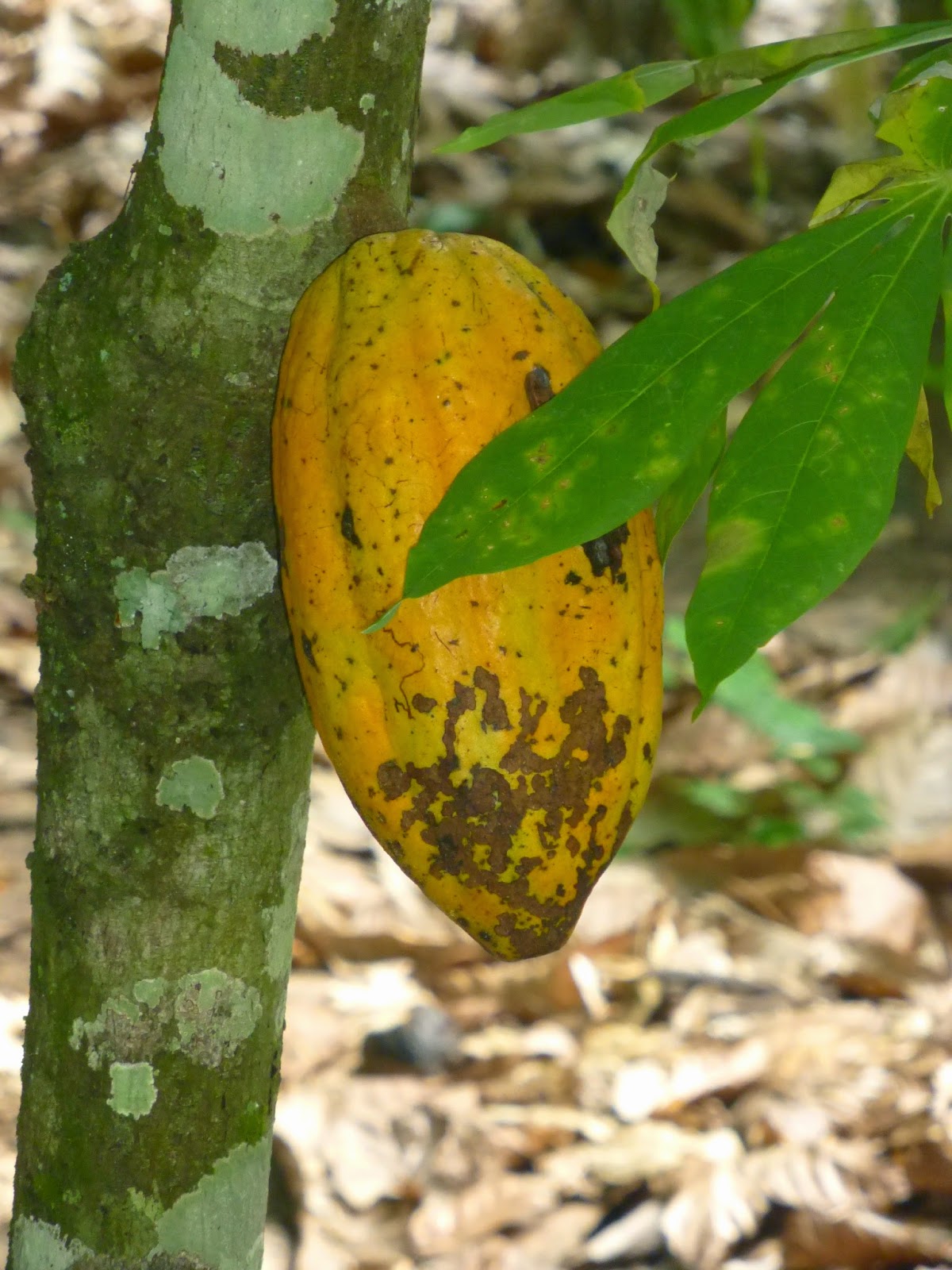
All the same, thanks to my gastrointestinal situation, I haven't done anything particularly interesting this week.  So here is a picture of a ripening cacao pod (Cote d'Ivoire is the world's top cacao exporter, which is great for me, a top cacao consumer) and one of some rice fields not far from here.  Why is it that when my stomach is upset my mind always goes to food?

Hopefully more of interest (but not Ebola-level interest) next week.


Sunday, 27 July 2014

Happy Eid-ul-Fitr!

Ramadan-related food advertising came as a bit of a surprise
Tonight, if the Conseil Supérieur des Imams (Superior Council of Imams) gets credible reports of a moon sighting in Cote d'Ivoire, Ramadan 2014 will end and all the good Muslims in the country can celebrate Eid ul Fitr, the breaking of the fast.  It has already been spotted in Saudia Arabia apparently.  If it's too cloudy though (and it is rainy season) they have to wait until tomorrow.

I haven't quite worked out religion here.  In theory the north is predominantly Muslim, but a lot of traders originally from the north settled all over the country, sometimes going back several generations, so there is a Muslim presence even in the supposedly more Christian south.  Daloa, right in the center, has a Grand Mosque in the middle of town,  but also a cathedral, and dozens of evangelical churches.  They say the country is about 40% Muslim and 30% Christian but that the majority is animist.  That doesn't add up, so I guess you can go with how you're feeling at the moment.

A lot of the locals, ones I work with but also people around the city, visibly observed the fast.  Almost all of the troops here did too, being from Muslim countries - the only exceptions were the Bangladesh Air Force pilots, who practically apologized as they shared their lunch with me after taking me to a remote camp - the military rules prohibit them from fasting on days when they're flying.

There is clearly a sense of honor in observing, because only children and the sick (or pregnant) are exempt, and a certain pride that comes with exercising patience, but I was most impressed by the gratitude that it seems to bring out.  Gratitude for the health that entitles each to participate, and for the food and drink which they eventually share, and for the sharing itself, with friends and family and even strangers.

Wikipedia says the usual greeting for the breaking of the fast is Eid Mubarak, or Blessed Eid.  I tried that out on one of the security guards as he left for evening prayers and he looked at me blankly, so I'm not totally convinced.  It's getting dark now, so to all the Muslims in Cote d'Ivoire who are looking to the skies, I hope you see the moon, and wish you and all those celebrating (or waiting to celebrate) around the world a Blessed Eid.


Grand Mosque of Séguéla, one of the prettiest, I think

Some interesting links about Ramadan here: Huffington postRamadan.co.uk, and on the religions of Cote d'Ivoire (in French) here: Abidjan.net

Sunday, 20 July 2014

On the job


Engineering is one of the field service support units providing backup for the good men and women, both military and civilian, of UNOCI's field services as they monitor human rights and the protection of children, and make sure that the demobilized groups are reintegrated into civil society, and rule of law is respected in the courts and the prisons.

My job is to make sure the mission has safe drinking water, and that all sewage is disposed of appropriately.  In practice this means keeping tanks like the one in the picture full of water with enough chlorine to kill any bacteria that might take our minds off our work, and dispatching our team of local plumbers and electricians to deal with leaks or problems with the "ablutions" (prefab toilet/shower blocks).  Yes, the position of Volunteer Water and Sanitation Engineer is as glamorous as it sounds.

Many of the other field service support staff are also volunteers, mostly from other African countries, with the occasional West Indian and south Asian.  The military contingents are each responsible for their own area of Sector West, and we have Bangladeshi, Pakistani, Nigerien (from Niger not Nigeria, whose nationals are Nigerians - tricky!), Moroccan, Jordanian and Beninese (what Google says you call someone from Benin).  All that I have met so far are very welcoming, and I'm never allowed to go back to Daloa without having at least had a snack and some juice, even though it's Ramadan and all of them are fasting.

I'm still a bit of a novelty around here.  The Pakistani crane operating unit who delivered the new ablution to a Bangladeshi camp this week thought it was worth a picture, so I had them take one for me too.

Sunday, 13 July 2014

Firsts

This is it, my first blog posting, first full month in Cote d'Ivoire, first weekend in my new house in Daloa, first peacekeeping mission, first time working with the military (not as organized as I expected!), first time doing water treatment, not just wastewater, and first time actually responsible for the water quality, not just the design (stress!).

I had never been in a country emerging from war before, and before arrival I had to do an online security training course.  It included tips on what to do when you find yourself in a minefield, or being shot at.  I was pretty apprehensive and you can imagine my reaction when they said I would be driving on my own between cities to the different camps.  But in fact the security situation is not a problem.  Staff who were here during la crise had a rough time, but now things are stable, and I was very happy to hear there aren't any land mines.  We drive around in our loudly labelled UN SUVs and trucks without any trouble.  

I'm getting the hang of it, little by little.  Last week I took my first trip on my own, driving home from the port of San Pedro, about 4 hours away under normal conditions.  But it's rainy season and one section of the road was half washed away.  It was all under control, the military was directing traffic, but it took a long time to get through.  I was prepared, and had lots of water and some snacks with me.   


All that water caught up with me later on, though, and I took a little side road into a cacao plantation to relieve myself discretely.  Mission accomplished, I tried to turn the car around but the ground off the path was very soft and I sank right in, up to the axle.  I was just getting ready to radio for a rescue (first time driving around in cars with CB radios) when a couple of young men came by and started to help dig me out.  About an hour later, and with the help of 3 more of their friends, I was back on the road.  The trip took about 7 hours, all told.  It seems that I'm not going to encounter "normal conditions" often here.

I'm looking forward to the other firsts that will come along in my next months in the region.  I'll do my best to keep you posted.